
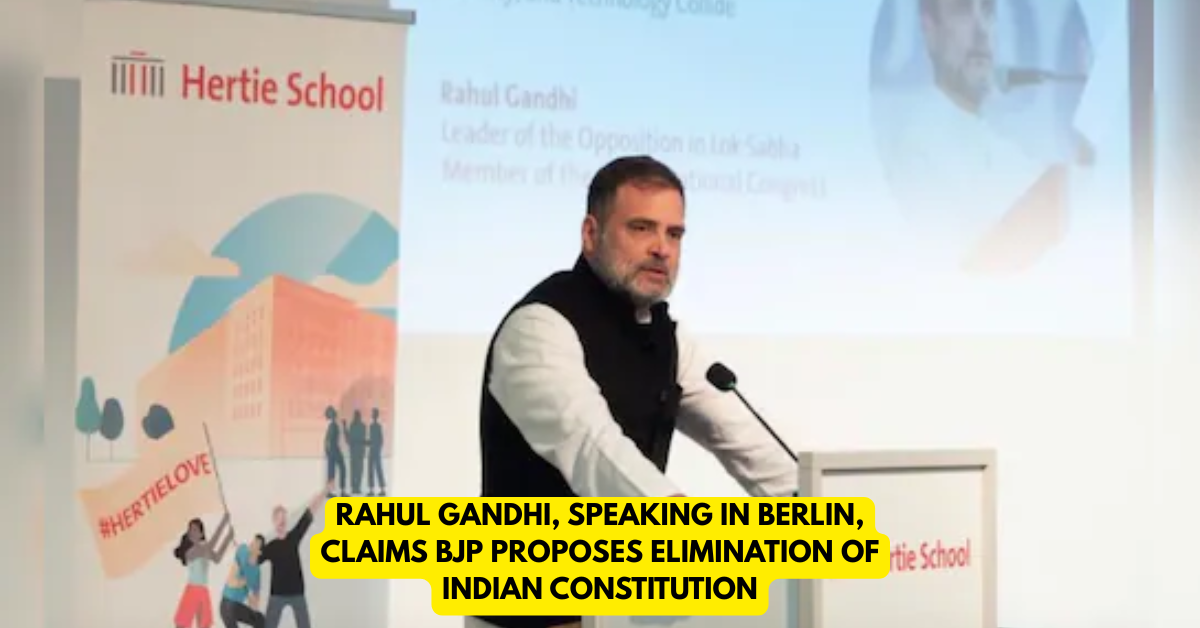
Berlin — In a bold and widely discussed address delivered in Germany’s capital, Congress leader Rahul Gandhi accused the ruling Bharatiya Janata Party (BJP) of advocating policies that, in his view, amount to a proposal to “eliminate” the Indian Constitution’s foundational principles. Speaking before a gathering of Indian students, expatriates, and civil society advocates, Gandhi’s remarks underscored deep political divisions shaping the national discourse as India approaches a significant election cycle.
Gandhi said that while the BJP frequently underscores national pride, cultural identity, and security, some of its legislative and policy choices reflect a tendency to downplay core constitutional values such as secularism, equality before law, and federal balance. “When the Constitution itself is treated as optional,” he told the audience, “we are not debating policy anymore — we are redefining the nation.” His comments were framed not as a literal claim about legal texts but as a warning about political direction and democratic norms.
The BJP leadership, which bases much of its public messaging on nationalism and development, dismissed Gandhi’s characterization as politically motivated. Party representatives reiterated their commitment to India’s constitutional framework, arguing that all major policies and laws passed under their tenure are rooted in legal and democratic processes. They described Gandhi’s remarks as misplaced political rhetoric, designed to energize opposition support ahead of key elections.
Gandhi’s choice to speak on this issue abroad added an international dimension to an already tense domestic debate. In Berlin, he emphasized the importance of democratic institutions, civil liberties, and independent judicial oversight, urging the Indian diaspora to remain engaged with developments in their home country and to advocate for transparency and accountability.
Political analysts said Gandhi’s remarks reflect tactical positioning by the opposition as India prepares for elections in 2026. They noted that invoking the Constitution — a document deeply revered across political lines — heightens the stakes of political competition by shifting the debate from routine policy differences to broader questions about democratic identity.
Reactions in India were swift and polarized. Within opposition circles, leaders echoed Gandhi’s concerns, calling for renewed focus on constitutional protections and equitable governance. Civil liberties groups also weighed in, urging all political parties to uphold democratic norms and refrain from rhetoric that could deepen social divisions.
Supporters of the BJP, by contrast, criticised the comments as an attempt to internationalize domestic politics and divert attention from governance issues such as economic growth, job creation, and social welfare. They argued that political disagreements should be resolved through domestic democratic processes, not framed as existential threats abroad.
For many observers, the episode highlights the heightened political temperature in India, where fundamental debates about identity, rights, and constitutional priorities now intersect with electoral strategy. Whether Gandhi’s framing resonates with voters remains to be seen, but his speech in Berlin has unquestionably added a new chapter to the ongoing conversation about India’s political and democratic future.