

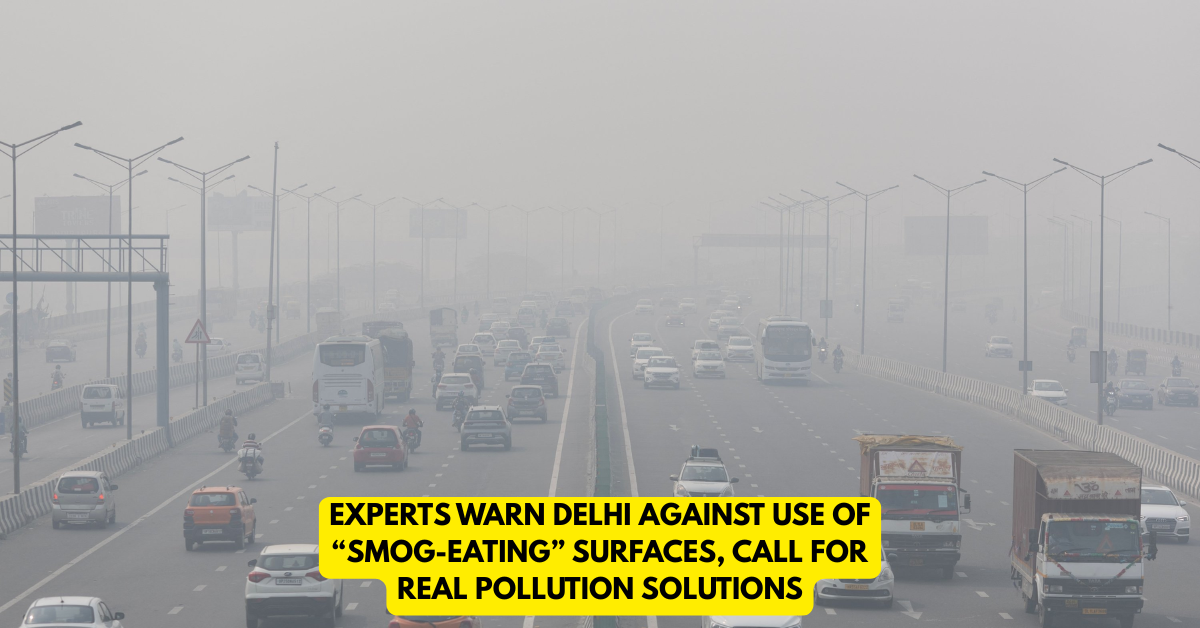
New Delhi — As Delhi grapples with its annual smog crisis, environmental experts have sounded a note of caution about the growing practice of installing so-called “smog-eating” surfaces — specially treated pavements and wall panels that are marketed as breaking down air pollutants.
Scientists and urban planners say these technologies, while innovative, are no substitute for robust air-quality policies, and may offer only limited benefits unless paired with stronger actions on emissions, transport reforms, and industrial regulation.
What Are “Smog-Eating” Surfaces?
Smog-eating materials are built using special photocatalytic coatings that are claimed to react with sunlight and break down nitrogen oxides and other components of urban pollution. Municipal bodies in several Indian cities have experimented with pavements, concrete barriers, and building facades treated with this material as part of efforts to improve air quality.
Experts Urge Realistic Expectations
Environmental scientists stress that such surfaces work only under specific conditions — especially adequate sunlight, moisture, and airflow — and their overall impact on city-wide air quality is likely to be marginal. “If these surfaces were a breakthrough, we would see dramatic improvement wherever they’ve been installed,” said one air-quality researcher. “But real pollution in a megacity is too vast and too complex to be fixed by coating a few walls or pavements.”
Critics also note that the costs of treating large areas with such materials are high, and maintenance needs are often overlooked. Unless deployed at a very large scale and supported by broader emissions controls, the benefit will be negligible.
What Experts Recommend Instead
Instead of relying on quick-fix technologies, specialists are urging a combination of stronger policy actions:
- Tightening industrial emissions standards and strictly enforcing limits for factories and power plants.
- Reforming vehicle emissions norms and promoting cleaner fuels and electric transport.
- Enhancing public transport capacity and discouraging private vehicular use through incentives and restrictions.
- Expanding green belts and urban forests to improve overall air absorption capacity.
- Better dust control measures at construction sites and roadways.
Officials in Delhi have said they will continue to evaluate new technologies, but emphasise that reducing the sources of pollution — not just treating symptoms — remains the priority.
Public Health at Stake
Delhi’s smog season routinely sees air quality dip into the “hazardous” category, with respiratory illnesses, asthma attacks, and other health complaints rising sharply. Medical professionals have consistently warned that long-term exposure to poor air quality poses serious health risks, particularly for children and the elderly.
As winter deepens, experts say that solutions must be both pragmatic and systemic. Measures like smog-eating surfaces may play a supporting role, but they cannot replace real strategies that cut emissions, manage traffic, and strengthen environmental governance.
For millions of Delhi residents, cleaner air will come not from coatings and pavements, but from concrete policy action that tackles pollution at its source.